1
The burden of the last years was to be a Jonah, fleeing the truth, thrown overboard and forced to survive. My lot was a loving marriage falling into misery with a wife that became relentlessly mean. By degrees she was progressively more unwilling to talk to me, collaborate in our close relationship, be reciprocal, kind, to love Rui together and see the complementary ways that each of us had love that was valuable to him. From earlier in the marriage than I’d been ready to know, she locked and shuttered all the emotional exits and disappeared into myths and well-worn paths of her upbringing. The grooves were left by extraordinary and intense traumas of early family history that few or none have ever been allowed to know: Machico believes she had an abusive alcoholic birth-father; this phase ended early with an escape, followed amazingly shortly thereafter by early abandonment by her mother, separation from her beloved sister, adoption by an aunt, horrific child abuse by a maniacal nanny, and an heroic ending in which the damaged child’s family was blissfully reunited. Achieving this dream transformed mother and sister into supernatural beings, impenetrably fused with her in a beatified family unit in which each other could do no wrong, and brook no criticism. No one was worthy to enter this holy sanctuary.
It was a tragedy with an uplifting ending that moved me. They triumphed together; in their hearts, the ecstatic relieved kids must have sworn never to be parted again. Machico kept photographs of the first days of their reunification mounted on wooden backing on a shelf in an honored place wherever she lived. If my son hadn’t been brutally torn from my life and abducted to Japan, I wouldn’t have taken it on myself to question the mode of this story too strongly, or to doubt the consoling and exhilarating effects it has had in Machico’s life. And especially, I would never have committed the sin of telling these tales out of school like I am doing now.
In 1943, Harold Arlen and Johnny Mercer wrote “One For My Baby,” a song of a lonely broken man’s dark 3 a.m. conversation with a bartender that Frank Sinatra sang so dramatically, he could make his fans swoon. It went:
I could tell you a lot
But you’ve gotta be
True to your code.
So make it one for my baby,
And one more for the road
I’m struggling here, because I still believe in that code. Everybody knows something about somebody, and best keep it to ourselves out of decency and respect. But the indecency she has inflicted on my baby and me makes a sham of the rules. The rule book turned into a joke book; it burned up in fire. She brought battlefield weapons. Is there a seemly diplomatic defense on offer? Rui’s mother has already turned to the nuclear option.
2
It wasn’t only Machico’s miserable babyhood that turned her into a sociopath who would scheme a child abduction, save up put-on accusations, and entice her Japanese friends and family members into conspiring with her to commit a premeditated, heart-breaking outrage. And there are more influences to understand about personality and how decisions got made. They weaved their way into her “interpellation” as a Japanese subject … by which jargon I mean the part of a person that embodies the social relations, mores, ideology, cultural stances, expected behaviors and received notions of a particular place, in a particular time, in a particular society. While I have loved someone who is Japanese, now I have become familiar with the claim that it is Japanese people who “do this sort of thing,” that few others among the human species would find it broadly socially acceptable, legal, or a right they hold precious enough to keep protected by the powers of the national state, as representative of the will of the people. There are myths and misperceptions on all sides of this set of beliefs.
In Japan, joint custody is illegal, parental alienation is common, and psychological damage from these practices is pervasive. This predilection isn’t a permanent innate state of geography or nature; it is learned, shared, emulated, and ingrained. It is a more, a customary practice. Difficult as it is to accept, it is believed in and practiced by actual people. How is it possible to kill off empathy en masse to the point that an entire nationality can be said to condone child abduction and the elimination of a child’s right to his most loving parent?
It lives not only in Ministry of Justice courtrooms and family law practices. But socially, it spreads like a virus spreads. We have to struggle to find words for this in order to explain the current epidemic. I snuck glances over Machiko’s shoulder as she trawled the Internet in her darkened room late into nights behind a closed door. She perched in her chair past 3, 4, 5 a.m., while our little Rui boy sighed and slept in bed a few feet away. Machiko pretended to work or, if asked, growled that she was connecting with other women through online social networks. Why would she quickly lower the laptop screen and look petulant when I slipped the door open to enter and kiss my sleeping child and lay with him a while before I slept? I kept seeing the same girlish, pink, white and blue pastel Japanese web pages with the little yellow “m” on the screen in front of her. It was only gradually that my suspicions about those nights became more substantial. Between visits to Machiko’s dinner table, she and her friends closed the door and pulled up those web pages when they came to visit. They spoke in hushed tones, agitated and secretive. I managed a few glances into the content; but automatic Japanese to English translation was absolutely awful in those days. I could discover only a few words and oddly linked phrases:
Abduction. Escape. Accusations. Exaggerations. Record keeping. Moving companies. Shipping companies. Helpful law firms. Collaborators. Advice: Keep a diary or log. Reduce your presence gradually. Give away unnecessary things. Lighten your load. Erase phone numbers. Reduce files. Secure passports. Cover every story. And don’t admit any light into the relationship. Steel your resolve. No tears.
It is a shared network. A sisterhood of disgruntled women. An abduction underground facilitated by the web.
I’m getting ahead of the story. Looking back I should have been wise enough to never have been surprised to find that a person reverts to type. Today, six nightmarish months after she kidnapped my son, I’m still reeling. The gun-smoke is still clearing, but I feel like I’ve spent an entire recent lifetime begging someone to please, please stop being so unnecessarily, unmercifully mean.
The flow of daily instances of Machiko displaying hostility and poor regard for me, and her disgust and displeasure at my presence in my home was inescapable and burdensome. Sweetboy littleguy Rui had a daily diet of this from his mother. He was subjected to watching her turn her back on me when I entered, and to her launching into virulent litanies of nasty criticism and blame aimed at undermining my ability to be present in the room with my boy, and at preventing him and me from enjoying the little remaining daily time we had to spend together. She displayed an endlessly expanding sense that she was entitled to this ugly behavior because she was somehow so aggrieved. She forced me off and out, to have less of the warm and casual time, the ball-tossing, car-rolling, wastebasket basketball shooting, balloon batting, crayon drawing, poem reading, bedtime wrestling, loving contact with my son that I craved and that I believe he still needs now as much or more than ever, just like I do. Machiko is without question an emotional abuser who felt at liberty to expose mean-spirited, brutal emotions in front of me and in front of my 4-year-old son. I was more and more driven out of her presence because I came to know that I could never expect anything better from her. I wasn’t given a choice. I curtailed some of my time at home against my better judgment just to avoid these painful encounters, and started to work late more often, grade and prepare papers at the office, eat meals alone, and grew more and more internally miserable at the predicament. I struggled to gain time alone with Rui whenever I could, but once it became necessary, Machiko could seldom be counted on to be absent.
***
3
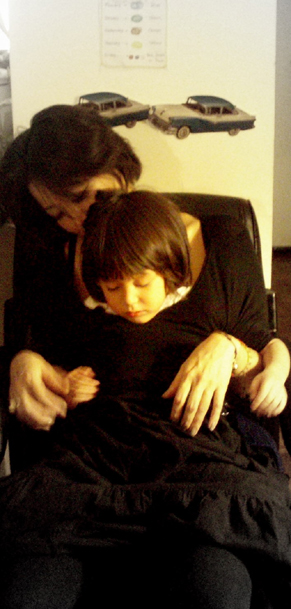
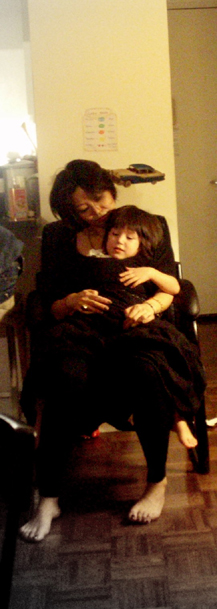

In the spring of 2010, Rui told me how Mommy had occasionally said to him, while they were lying in bed cuddling before sleep, “Wouldn’t it be nice for you and me to just move to Japan and live there without Daddy? Would that be ok with you?”
Of course, I told him that that made me feel so bad, and that her saying such things was a terrible thing for her to do. Conflicted about what to say or do in response, I had to express opposition and distrust of her and to try to mediate the effects of this kind of behavior on Rui, who was victimized by it. It was obviously unhealthy for him to see the pain she was causing me, but it was unavoidable that he witness a certain amount of it. It felt vital to me and my interest in developing a normal healthy loving relationship with my son that I NOT allow these negative, divisive expressions of hers to go unanswered. I was forced to tell him how wrong she was in order to be sure that he knew that I was trying with all my might to protect him and stay together with him at home. It was very important for me to let him know that I was not — at that point — a party to breaking up his family home; and that even though that was her aim, I opposed it because of the love I had for him and the tremendous need and desire I had for us to be together. I told Rui so many times that I loved him and wouldn’t allow the time I had reserved to be together with him after work and on weekends to be taken away. I didn’t hide from him the fact that I felt Machiko’s words were exerting a great deal of stress on all of us.
Her behavior was threatening to the foundations of his well-being, his development of healthy emotional attachments to both of his parents. She wanted his attachment to her to be exclusive, and kept him in a bed with her every night behind a closed door. More and more, she threatened and worked to undermine the on-going course of his attachment to me. She denied that this was true and became more hostile every time an element of it was brought to her attention. She couldn’t bear any hint of critical dialogue, no matter how roundly it was couched in terms of protecting Rui. And with the stakes so high, I experienced similar resistance.
Machiko began to make my time with Rui increasingly difficult by broadly sabotaging our play time together. At times she was absolutely unable to contain her resentment when Rui and I were enjoying ourselves in the evening. She burst angrily into the room where we played to complain that we were making too much noise laughing and playing, that it was too late for such play and for such behavior. She was visibly enraged at these times, and verbally abused me with angry scolding. She would then abruptly shift her tone to a pleading one directed at Rui, and held out her arms for Rui to hug her neck while she whisked him away to her bedroom when it suited her that it was time for him to stop being happy, and join her in sleep. These incidents made me terribly queasy. One second she was mean and menacing; the next second, demanding that Rui succumb to her emotionally. Sometimes he stole meaningful glances back at me in obvious discomfort as she carted him out of the room. Despite her protests to the contrary, she knowingly frightened him at these times. I followed them if I could, tried to show him my shrugs and smiles and to reassure him that it was emotionally safe for him to be with his mother. But I no longer believed it.
She used bedtime as battle time in the dissolution of our marriage. She took complete liberty to determine Rui’s bedtime schedule at her whim. She kept him out late at restaurant dinners with strangers who were her business clients or with her friends if that suited her, even though I was waiting at home from work for my time to be together with him. But she responded with outrage and anger if we enjoyed each other’s company at a time that she decided was not the right time. She effectively prevented me from putting my son to bed at night by usurping the tasks associated with it, and by displaying her hostility to my presence. To be present at my own baby boy’s bedtime, a favorite time of day to be close to him, I would have to be defiant and demand to interpose myself into her determined exclusive handling of Rui’s clothes change and washing up. In the struggle to be a good parent who loves his child, I couldn’t bear to agitate his dreams at night by asserting that right too strongly, too often, when he needed peace and sleep. If I crawled onto the big bed to kiss my boy and cuddle him to sleep, it was met by Machiko’s glares, turning away, rigid angry huffs and dirty sidelong glances. The nights would frequently end with a loud, stiff, terse, cold, and dismissive “good night” to me, spoken like a command, an announcement that I was supposed to leave the room now, as the general’s decree had been issued, a proclamation that I could not stay next to him without a lot of sharp elbows and contentious, dour looks. This dance would force him to be with her alone, and to succumb to her as his only source of comfort, one he could not afford to risk by asking that Daddy be allowed to stay. I remember him asking her in the plaintive sound only a four-year-old can give voice to, why I was being commanded to depart the room.
I know how this was affecting Rui. She was forcing him to choose her at the demanded cost of dividing from me. He would say his goodnight to me on orders, and in a heartbeat she’d grab back his attention to a kid’s book or iPhone video she intended to share with him, alone. The more I stayed, the colder and angrier his mother’s glares and orders that I had to leave. Machiko didn’t have to read the new textbooks on parental alienation; she was a natural expert practitioner.
***
4
Rui was given another important message as well, about living in the U.S. Emigres all expect to pine for home together and compare the new place of residence unfavorably to it. Every expatriate and migrant knows how the conversation turns when the door clicks shut or the bar music fades enough into the background, when the locals are at a safe distance, few enough in number, or absent altogether. People will commiserate with their buddies from home. I can accept this. I’ve done my share of it.
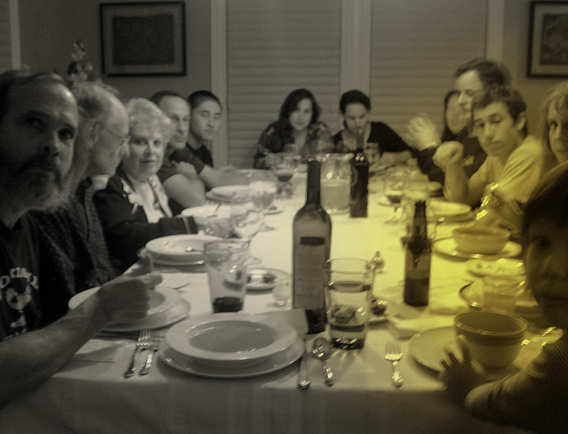
Rui and I went to see my family in Texas for a holiday visit at the end of 2009, leaving an unhappy Machiko in New York to spend Christmas with people she liked better than she did me. We arrived at my brother’s house and were soon joined by a big group of 12 or 15 relaxed, excited family members. It was a jolly night together, everyone talking at the same time, making small fusses over seeing my wonderful, sweet, handsome, charming no longer toddling son. I remember staying protectively close by his side the first night, brushing back his hair and smiling at him, making sure he felt safe and comfortable with all the unfamiliar relatives there who were not part of his everyday life at home in New York. When we all sat down to a holiday dinner a short time later the first night, Rui was next to me. Rui saw everyone being sociable and seemed to be enjoying it. He was emulating them the way kids do, feeling he wanted to talk and jump into the conversation with them. Just past four years old, he spoke up amidst the vocal clamor and clanging of forks. And to me and to anyone who might hear, seemingly out of nowhere he said, “I don’t like Americans.” Everyone was talking so they didn’t really hear him; but I did. He was smiling as if he d said it hoping it would impress someone with the acuity of this thought. He was trying to keep up with an adult conversation.
I must have looked a bit pink and shocked, so I breathed a big breath and patted him, lowered my head to his, leaned in and quietly told him that maybe he didn’t quite understand that everyone there that night was American, and in fact, he is American too! I tried to dampen down any embarrassment he might have felt at having said something that would make him look silly or wrong. He was just past 4.
5
From where did he get this performatively savvy opinion that he wanted to state at that moment of sociability to prove his smarts? It could only have come from his mother, who frequently spoke that way in front of him to all of her friends, to me, and to anyone other than the American business people she was dependent upon. They were the recipients only of Machiko’s superficial charm and sycophancy. She was quite cynical and it wasn’t for me to decide whether or not she should be critical of Americans, not only for shortcomings of American society that were open for discussion in any home of mine, but at a much more visceral level due to her dislike of Americans’ manner and mannerisms – their way of speaking too loudly; they were too coarse, too vulgar, not coated in the cosmetic niceties and mannerisms she preferred and was accustomed to. She made no secret of this feeling and shared it with Rui, trying to bond with him through this as well as all the other ways that she sought to make her relationship with him special, particular, and exclusive.
The sad, sad tragic truth is that the exclusionism of her relationship with him, coupled with her open negativity and hostility towards me, ended up working some of its magic on him. This is where the wayward, aberrant elements of alienation began to bear their sour fruit. Wanting to avoid the tension of the unpleasant scene, he sometimes hid under a desk or table when I first came in. Despite the dread I was developing of Machiko’s unabashed displays of contempt, I still always approached the apartment half running from the train to get to see him. And at last, some months following his 4th birthday (a developmental milestone of rebellion and self-assertion), I would then find him beginning to hide behind his mommy’s legs when I came home ready to play and eager to show him how much I loved and missed him. He became increasingly fussy and negative about going out to parks and playgrounds with Daddy on Saturday, distracting himself by clinging to his boxes of toys or begging his mother for TV. I wondered how best to insist with a small boy. But once it began to take more persistence from me to have our Daddy/son days out, his mother and Japanese baby sitter started saying – and repeating to each other and others – that I had treated him roughly. And then, unbelievably, they made the now seemingly momentous decision to report that he said to them that I had hit him.
This stung more sharply than any hard flat-handed slap ever could. I literally quivered at hearing this. It was either bald mendaciousness or attempted brainwashing. I felt punched in the gut and heart-sore. I had never been angry with Rui. In the downward spiral of the marriage, I was hurt, and that showed. I was disturbed and deeply discouraged by his mother’s meanness, and that showed. But the only emotion I ever felt about Rui was that I was in love with him, and I told him so every day without fail.
But the hypocrisy of her accusing me of hitting made the gall rise in me. This was from a spouse who had hurled hard, ceramic toys at me and busted out the glass in the French doors of our first apartment. She had torn my flesh with her fingernails when she became frustrated; she kicked me, and shoved a booted foot into my gut over minor disagreements about our last apartment move. A woman with a violent history was now lying that I had struck my son. She was further spurred by this device. She lost her sense of limits.
Machiko knew I was well enough informed about parents who believed in hitting their children. I had my own experiences to teach me and about which she had been told, and I am incapable of it because I care for and relate to children instinctively like peers sharing the same reality. I handed out readings and discussed this issue in my classes for 25 years. I’ve practiced making a convincing case against hitting kids again and again with my students, some of whom come here from countries where many believed in traditional forms of parental authoritarianism and punishment until very recently. She knew I regarded hitting as an illness. It was and is not me.
Machiko manufactured a crisis from this, and it became her latest folly. She wanted to talk to me about it, she said (this from a woman who never otherwise willingly spoke to me any more). I was quite disgusted by her questioning, and told her 100% of the truth, angered by this person who had thoroughly betrayed me, now embarking on another course of betrayal.
She didn’t take my word; instead she kept the story alive around our home. Seeking external support for her scheme, she called a battered women’s group to ask them, she told me, for advice. Of course, the women’s group informed her that they would have to turn her report of this over to a New York City child welfare agency. They were required to do this by law. Looking back I can see that Machiko was overtaken then. By overstepping her ambitions, it backfired on her. In Japan, she might have used this strategy to separate my boy from me with no legal recourse to impinge upon her success. But it wasn’t working the way she wanted in New York, where for all their myriad historic flaws, child welfare agencies were unlikely to let this go without an investigation. Now we were looking at the possibility of having caused child welfare agencies to question us and visit our apartment to determine if Rui was being abused.
Could anyone have guessed that such insanity was taking place inside my home? I can remember an almost dream-like moment here, floating up above looking down and wondering just exactly whose life was being lived below, as we crouched in a doorway talking about what consequences might follow from the inquiry she’d made to the DV support group.
Machiko finally understood that she had done wrong and had jeopardized our son. She was contrite, and in a stunning turnabout, she sought my help. I told her that she must call the women’s group and inform them of her mistake. She was afraid that suddenly out of nowhere our son could be taken away. Within a day or so, she called and pleaded to the service that she had been wrong, that it had all been just a “what if it happened?” inquiry, and with all her pleading, they finally bought it and called off the emergency. In fact no authentic emergency had existed because no hitting or rough treatment had ever occurred. Seeking weapons as her lawyer Kensuke Ohnuki and her online web-friends had instructed her, Machiko was trying to play the agencies to find a way of leaving a trace of a complaint for the benefit of an imagined future encounter with a family court judge.
I didn’t have the full picture yet, but I was internally outraged by the extremity and outright stupidity of Machiko’s action. My wife was so eager to make someone believe I was unworthy as a father, to find justification for her machinations to steal and hide him in Japan, that she had been willing to try to extrapolate from my sadness and frustration with her and parlay it into an extraordinarily risky lie.
By this point I was fully in doubt about her stability and suitability as a mother, but I was unwilling and uncertain how to act yet. I was paralyzed by the grief I was trying to manage. It sapped my strength.
Then, shortly after, came another trip to Japan … for business.
A three week trip in June, she said, with Rui.
I objected. I said that she had just been there a short time before, in April, our son in tow.
She said, well at least they would be back so I could spend summer vacation with him this time, all of it, because they would return in the first week of July.
I withdrew my protest.
***
6
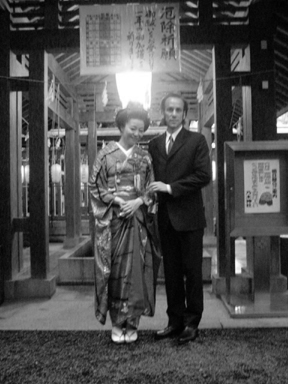
As it went, Machiko The Real was not the person I met and fell in love with. That person was Machiko the Experiment. Like a teenager or 20-year-old tasting independence and trying on new personas that would eventually be discarded (she was 30 years old when we met), Machiko turned from the blue-jeaned, unassuming, broad-minded, generous-hearted, compassionate person I loved, back into the over-driven workaholic, peevishly demanding person she had been prior to her escape from Japan to New York. Of course, I didn’t know her from her “before” picture, the one of the immensely competent woman who avoided having a boyfriend, worked 20-hour days for her Jou-shi– her boss – served and pushed her work collaborators, and had a reputation for toughly demanding, verging on abusive, perfection of staffers. If I had known that woman, I might have respected her powerful character, but I probably would not have panned in for a close-up.
Most likely no one in her work circle knew for certain about Machiko’s private, altered states of paranoia, seething, and demented blaming. They told me they had seen her as a relatively private person and member of a uniquely tight, closed family; but it’s doubtful that they could look into her and see the desperately unsafe adult slipping helplessly into rages followed by catatonia, born of childhood trauma. Machiko’s protected projection of herself was a creature of the new economy. But when she worked, she looked enslaved to my eyes, a semi-hip Salaryman; a type well-known to my Japanese friends. Japanese business practice still demands obscene amounts of obsequious devotion, and she provided it as 24-hour service, at an enormous price of exhaustion and stress to herself. To satisfy work relationships that are feudal, with permanent glass ceilings specially made for women, she brought herself near to nervous collapse time and again. Who did she owe herself to? She worked for hip fashion industry men that absorbed creative credit and kept the financial benefit. Her niche of marketing managers who played bohemian poetes maudits with a deeply ambiguous message clinically extracted a counter-cultural, DIY façade for their stratum of consumers to don and bask in. The surface could be gentle, non-conformist or rebellious; but it was a suit of clothes, and the game was no less mercantile and thirsty for having an iconoclastic surface. When she came here, Machiko was escaping life as a nose-to-the-grindstone sidekick and on-call right-hand man, one-and-a-half careful paces behind creative directors and self-interested creators and geniuses. It was the life she left by marrying a much more humbly disposed (and humbly employed) me. For a time she was deeply sick of the mini-fiefdoms of fawners who laughed and smiled when the moccasined, leather-booted bosses did. I felt she could reclaim her freedom and live without them, but the pull of The Real was strong. She pined to reclaim her place in the circle and re-assume the pose. I learned that our marriage had started in a vacation from herself, and that she actually didn’t really want to be away for long. We had a gentle, sweet, funny, earnest, open-hearted boy together, and thus satisfied with her reinvention, Machiko The Real grew back out of her temporary dormancy. On the way to extricating herself from our family, she became as sharply resentful as the trapped child she had once been, and was every bit as abusive in her way as the perpetrators and victim-seekers of her childhood. If she couldn’t sustain the customs of her former life, she was going to steal them. She assumed that hers was the real control, the one that mattered; that she had the only thing Rui needed, and decided to drive me out. Ultimately, she cheated every one of us and stole him. I just wish that Rui and I could have been part of a less ruinous drama.
***
7
It’s impossible for me to understand the level of amorality that must underpin parental abduction of children. It’s even harder to imagine how this amorality can be committed to under the guise of loving or caring for a child. Amorality might just be the morality of repression. And it seemed to me then as if the Japanese had written the book on this sort of repression. Social order demands on the individual anywhere, if they are extreme and severe enough, can easily overwhelm the usual wired-in need for sympathetic communication, resulting in shame, depression, pathological hiding, dishonesty, self-deception, and alarming surges in addictive behaviors. We can’t unsee the compulsive and driven ways that stressed people now seek solace in high rates of pathological or morbid habits, escapist obsessions, addiction to electronic devices and pain meds. Repression is everywhere acute and profound. Virtually any page of a good study of the impact of contemporary crisis and insecurity on the incidence of depression will show us struggles that parallel these behaviors. Here’s one from an articulate and absorbing book by Terence Real, describing what was once and is still often seen as a peculiarity of the social demands that beset men in the competitive capitalist social environment of homo economicus:
Traditionally, we have not liked men to be very emotional or very vulnerable. An overtly depressed man is both – someone who not only has feelings but who has allowed those feelings to swamp his competence. A man brought down in life is bad enough. But a man brought down by his own unmanageable feelings – for many that is unseemly.
“Ashamed of their feelings and refusing help,” Japan has a suicide rate that has consistently dwarfed that of other industrialized OECD countries. Japanese school kids have an often remarked upon and studied reputation for bullying, shunning and scapegoating targeted classmates who don’t repress their sparkling difference and conform. In my understanding at least, an untenable level of socio-psychological repression is the cause of the effects of intense group conformity coupled with a lack of moral guilt.
Repression is doing its dirtiest dirty work. It was once unfathomable to me that a society of adults could exist in our time that could condone parental abduction and would weaponize exclusive custody of children. It was inconceivable that a people could care so little for the human heart that it could harvest deceptive plots, schemes and strategies of child abduction and parental exclusion across class, among its young working women, its judicial bureaucracies of men, and its renowned prime ministers. I believed that no reason-enabled community could systematically and remorselessly write parents out of the lives and histories of their beloved children, and do so as a matter of state policy. The brick in this wall was cheap, I thought. It had to fall.
I was so poorly-informed. I was blinded.
I beg for the demise to come sooner than later, for the sake of my son.
I sit and look out upon all the sorrows of the world, and upon all oppression and shame,
I hear secret convulsive sobs from young men at anguish with themselves, remorseful after deeds done,
I see in low life the mother misused by her children, dying, neglected, gaunt, desperate,
I see the wife misused by her husband
I mark the ranklings of jealousy and unrequited love attemtped to be hid,
I see these sights on the earth,
I observe the slights and degradations cast by arrogant persons
All these — all the meanness and agony without end I, sitting, look out upon
Walt Whitman
 For Rui Boy
Hi brian….I’m gib..a canadian american living in costa rica. I’d like to email you privately. I’m in the pre abduction, (to japan), stage at the moment. I’ve just now found your website….if you give me your telephone # I can call you for free on my magic jack system. I feel your pain, I’ve been away from my 7yr old daughter for almost a year now. Nothing could possibly be more wrong and uncomfortable for me or her. Get in touch any hour of the day by phone if you like…I’ll see that you’ve called and call back from here….or email me of course. Until then hermanos….gib
406 992 2091
LikeLike
So social change happens one of two ways:
1. A number of significant people take action (think Elizabeth Taylor taking on AIDS); or
2. A significant number of people take action.
I think you’ll have better luck with number 2. In this day and age, of the internet and digital publishing (and regular print publishing), write this book, Brian. Pitch it to a publisher. Get the story in print. Then, you can get on radio and TV talk shows. You will partner with others in similar situations. You’ll need to create the political will for change. It won’t be easy. Turning a massive ship never is.
But Buckminster Fuller talked about the “trimtab.” It’s the little rudder on the big rudder of the massive ship. Turn the trimtab, it turns the rudder, and the ship turns.
I think your trimtab is your story and your passion for getting your son back (and the fact that you’re a terrific writer doesn’t hurt). Write the story, Brian, keep writing. Write a query letter to a publisher. I will help you if you don’t know how.
Let us get this story out of your head and heart and body and soul and into the public’s eye. Then, we will watch the miracles happen. And your son. Come. Home.
LikeLike